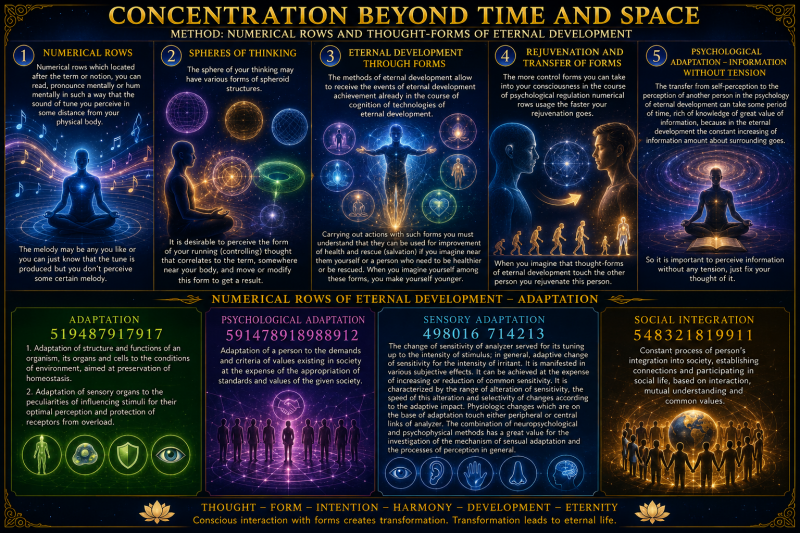
In periods of transformation, transition, and accelerated development, the human being often passes through phases of inner reorganization on many levels: physical, emotional, psychological, sensory, and spiritual. Experiences such as increased sensitivity, uncertainty, fatigue, emotional intensity, or a feeling of disorientation may accompany these processes as consciousness adjusts to new perceptions and informational structures.
In the Teachings of Grigori Grabovoi, the primary task is to ensure harmonious development. Therefore, such experiences should be consciously controlled and normalized through methods of concentration, including concentrations for adaptation.
Adaptation can be understood as a natural process of harmonization and normalization within development.
The Teachings of Grigori Grabovoi describe adaptation as the adjustment of the organism, organs, cells, perception, and consciousness to environmental conditions while preserving inner balance and homeostasis. This includes physical adaptation, psychological adaptation, and sensory adaptation, the gradual refinement and stabilization of perception itself.
During periods of rapid inner or outer change, the nervous system and sensory structures may receive an unusually large amount of information. This can temporarily influence perception, emotional balance, concentration, and the general feeling of stability. For this reason, it becomes important to perceive information calmly, without inner tension, pressure, or overload. Sometimes it is enough simply to observe a thought gently and allow consciousness to organize perception naturally.
The methods of concentration and psychological regulation through numerical rows may support this process of harmonization.
The numerical rows may be read silently, mentally pronounced, or softly “hummed” inwardly, as if the sound or melody exists at some slight distance from the physical body. The exact melody is not important. What matters more is the quality of perception and the formation of harmonious thought-structures connected with development.
Thought may be perceived as a sphere, a luminous form, or another subtle spheroid structure near the body. Through concentration, these forms may be moved, expanded, softened, or modified according to the desired result.
The Teachings explain that such forms may support restoration, harmonization, rejuvenation, and conscious development. Gradually, adaptation itself becomes more harmonious as consciousness learns to interact with information in a calmer and more stable way.
The following numerical rows are associated with adaptation and normalization processes:
Adaptation
519487917917
Associated with:
- adaptation of the organism and its functions to environmental conditions,
- preservation of homeostasis,
- harmonious adjustment of sensory and physiological systems.
Psychological Adaptation
591478918988912
Associated with:
- adaptation to social conditions and collective structures,
- integration of values and external demands,
- stabilization of consciousness during periods of change.
Sensory Adaptation
498016 714213
Associated with:
- regulation of sensitivity,
- protection from sensory overload,
- harmonization of perception and nervous system response,
- tuning consciousness to varying intensities of external influence.
The process of eternal development takes place gradually through knowledge, observation, concentration, and conscious perception. Adaptation may sometimes require periods of silence, rest, simplification, and inner stabilization while new informational structures integrate within consciousness.
The calmer the perception of information becomes, the more harmoniously consciousness can organize reality and support development.
Transformation can then be experienced as a gradual alignment with life, consciousness, and the eternal potential already present within every human being.
ETERNEL
In Love with Conscious Creation